Performance Study: Magnetization Plateau in a Mixed-Spin Chain
This performance example demonstrates how QS³-ED2 can efficiently handle site-dependent spin magnitudes and magnetization-sector constraints using
list_spin.datlist_NODmax.dat
These features allow exact-diagonalization studies of mixed-spin systems, which are difficult to treat with traditional ED implementations.
As a representative benchmark, we analyze the spin-dependence of the magnetization plateau width in a one-dimensional mixed-spin chain consisting of alternating spins
The plateau occurs at
Model Hamiltonian
We consider an antiferromagnetic mixed-spin chain described by
with periodic boundary conditions
Here
- \(\hat{\mathbf S}_{2j-1}\) : spin-\(S\) operator
- \(\hat{\mathbf s}_{2j}\) : spin-\(1/2\) operator
The coupling constant satisfies
and we set
as the unit of energy.
The system contains \(2L\) sites corresponding to \(L\) unit cells.
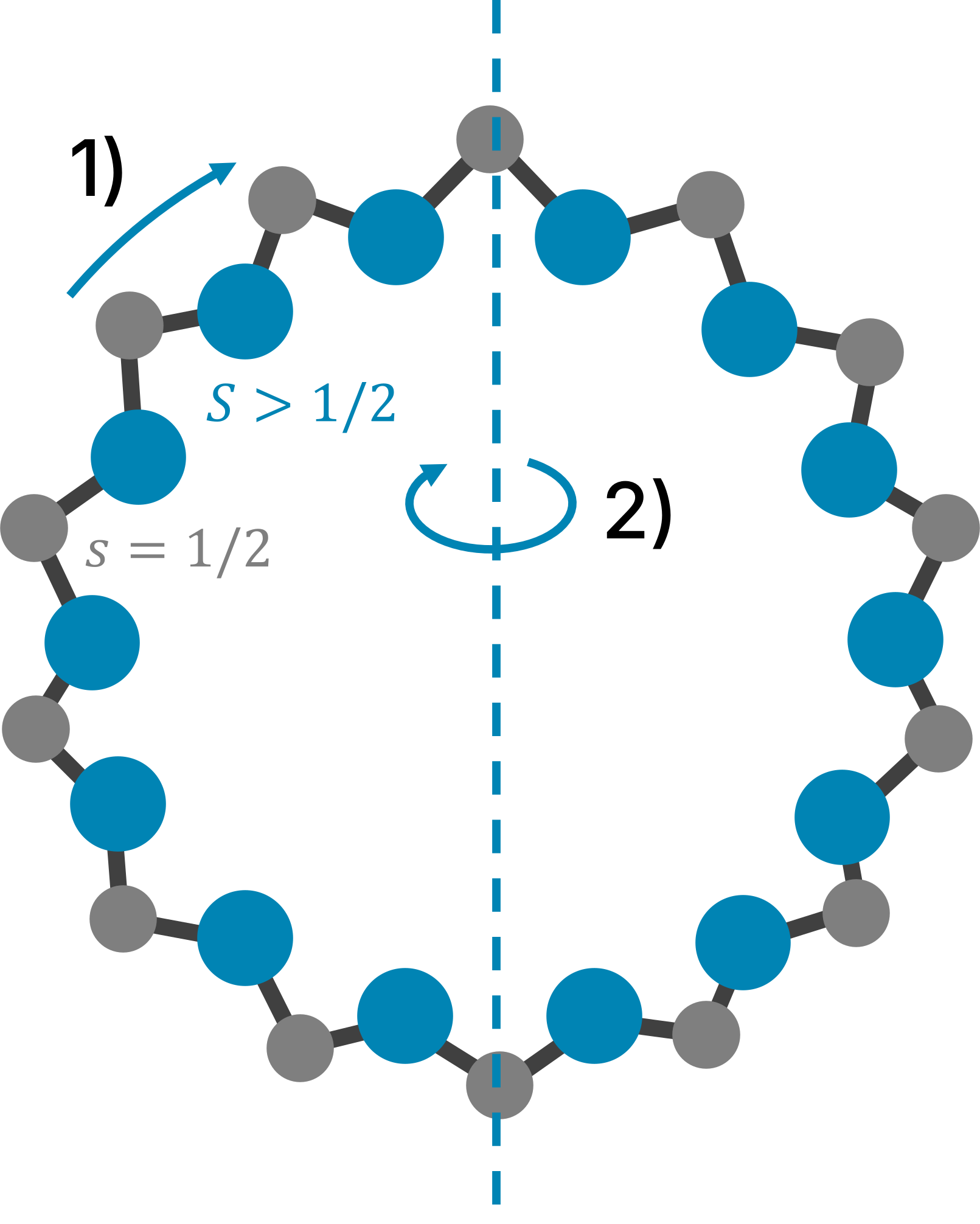
Symmetry
The Hamiltonian is invariant under
- two-site translation
- site inversion
The ground state appears in the symmetry sector
- momentum \(k=0\)
- even inversion parity
corresponding to
in the ED2 input file.
Saturation magnetization
The saturation magnetization is
For the alternating chain
this becomes
Magnetization sector
We denote the number of lowering operations from the fully polarized state by
In QS³-ED2 this corresponds to
At the plateau position
the lowering number is
Therefore the plateau lies between the sectors
and
QS³‑ED2 Input Configuration
For a system with \(2L\) sites
The symmetry sector is specified as
The local spins and lowering limits are defined using
while the interaction pairs are specified using
Table 1: Structure of the Input Files
The following table summarizes the structure of the input files used in the mixed-spin chain example.
| list_spin.dat | list_NODmax.dat | list_p1.dat | list_p2.dat |
|---|---|---|---|
| S | min[2S, NODmax] | 3 | 1 |
| 0.5 | 1 | 4 | 2L |
| S | min[2S, NODmax] | 5 | 2L − 1 |
| 0.5 | 1 | 6 | 2L − 2 |
| S | min[2S, NODmax] | 7 | 2L − 3 |
| 0.5 | 1 | 8 | 2L − 4 |
| … | … | … | … |
| S | min[2S, NODmax] | 1 | 3 |
| 0.5 | 1 | 2 | 2 |
Column descriptions
list_spin.dat
Specifies the local spin magnitude at each lattice site.
list_NODmax.dat
Defines the maximum number of lowering operations allowed at each site.
For a spin‑\(S\) site the maximum possible number of lowering operations is \(2S\), therefore the constraint is written as
to ensure consistency with the physical Hilbert space.
list_p1.dat, list_p2.dat
Define the interacting site pairs used in the Hamiltonian and generate the alternating couplings along the chain.
Determining the Plateau Width
In a magnetic field \(h\), the ground state minimizes
The critical field between neighboring magnetization sectors is
Thus the plateau width is obtained from the energy difference between the sectors
- \(N_{\downarrow}=L\)
- \(N_{\downarrow}=L-1\)
Finite‑Size Behaviour
Finite-size effects are extremely small.
Accurate results are obtained already for
Benchmark Result
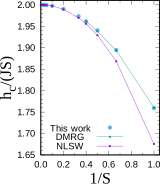
The numerical results
- reproduce DMRG results for small \(S\)
- approach the nonlinear spin‑wave prediction in the limit \(S \to \infty\).
Summary
This benchmark demonstrates that QS³‑ED2 can efficiently treat mixed-spin quantum systems with
- heterogeneous local spins
- flexible magnetization-sector constraints
- symmetry-reduced Hilbert spaces
These features make QS³‑ED2 a powerful tool for investigating quantum spin systems with site-dependent spin magnitudes.